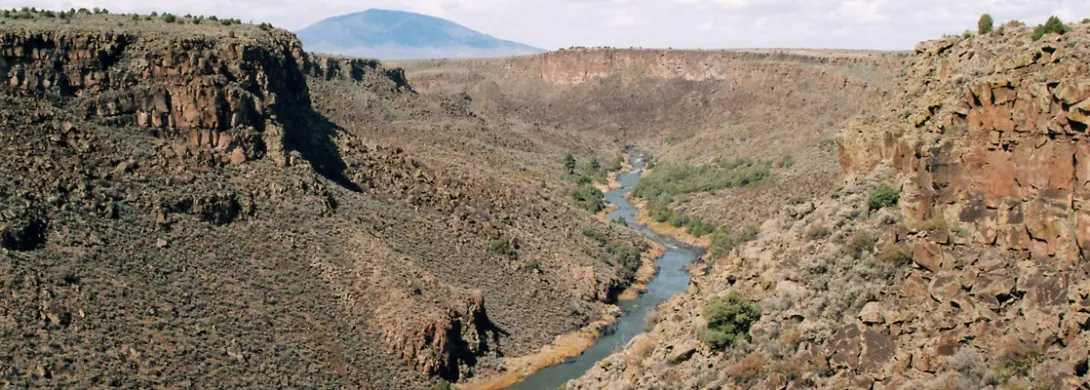
October may be the best month of the year at the Wild Rivers Recreation Area, north of Questa. Summer heat has left the gorge, the light is low and clear, and the trails that drop 800 feet from the rim to the Rio Grande are far more forgiving than they are in July. The recreation area, managed by the Bureau of Land Management within the Rio Grande del Norte National Monument, protects the place where the Red River joins the Rio Grande in a deep canyon cut through dark volcanic rock.
Start at La Junta Point. The overlook there, which the BLM notes is wheelchair accessible, gives one of the most dramatic views in New Mexico: both rivers visible far below, meeting at the bottom of the gorge. The nearby campground and picnic areas remain open, and the 13-mile Wild Rivers Back Country Byway along NM 378 links the overlooks, trailheads and five campgrounds. From the stoplight in Questa, drive north on NM 522 for about three miles, turn left on NM 378, and follow it about 12 miles to the visitor center area.
One warning matters before planning a hike. According to the BLM, the La Junta Trail is closed until further notice due to unsafe trail conditions. Older guidebooks still describe it as the best route to the confluence, so do not count on it. The BLM says access to the confluence area and the lower canyon can still be reached by hiking down the Little Arsenic or Big Arsenic trails and connecting with the River Trail along the Rio Grande.
Those alternatives are serious hikes, not strolls. The Big Arsenic Trail drops about 680 feet in roughly a mile, passing springs and petroglyphs on its way to a primitive riverside campground. The Little Arsenic Trail is steeper still, dropping about 760 feet in a mile to deep pools on the Rio Grande that anglers prize. The BLM cautions that trails here are steep and technical, with elevation gains of 300 to 800 feet, and that hikers need sturdy shoes and plenty of carried water. A good rule from local trail guides is to allow twice as long for the climb out as for the walk down, and to remember that the bottom of the gorge can be warmer than the rim.
Anglers should find fall encouraging. The New Mexico Department of Game and Fish fishing report published in early October rated rainbow trout fishing good on the Rio Grande near Questa on olive streamer flies. A valid New Mexico fishing license is required, and current regulations should be checked before fishing. Rim-top options suit anyone not ready for the descent: the level Rinconada Loop and Red River Fault trails explore the pinyon-juniper plateau, and watchable wildlife in the area includes mule deer, bighorn sheep, elk, red-tailed hawks and mountain bluebirds, in ancient pinyon and juniper forest the BLM says includes 500-year-old trees.
Practical details are simple. Day use is 3 dollars per vehicle, with an annual pass available for 20 dollars. Developed camping is 7 dollars per night for up to two vehicles, and inner gorge primitive campsites are 5 dollars per night, paid at self-service stations. There are no services in the recreation area, so arrive with water, food and fuel from Questa or Taos, start descents early, and leave enough daylight for the climb back to the rim.